Ionia County Dog Registration Information
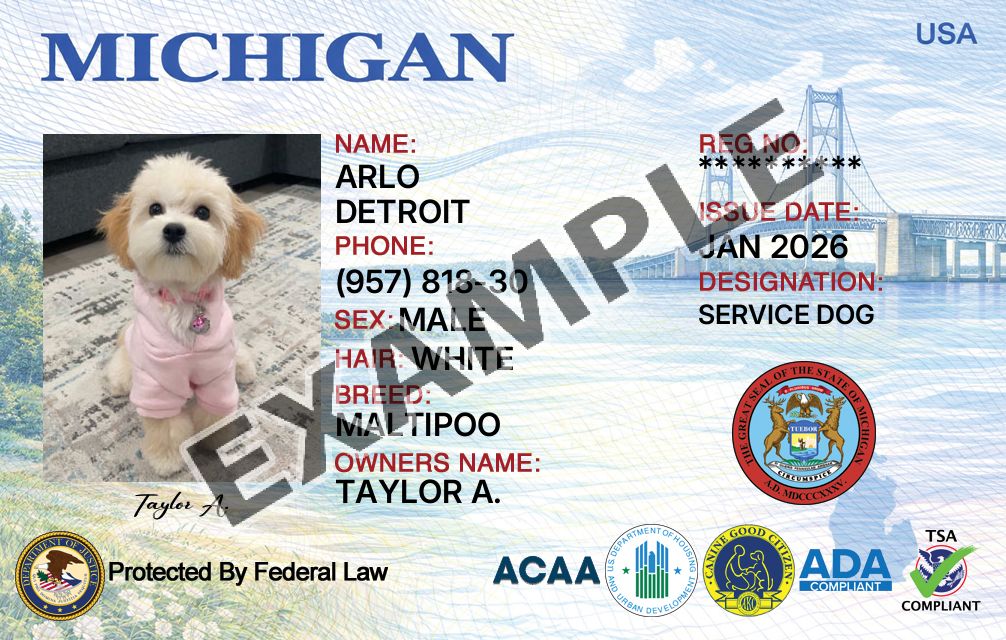
Service Dogs and Emotional Support Animals in Ionia, Michigan
If you’re searching where do I register my dog in Ionia County, Michigan for my service dog or emotional support dog, the most important thing to know is this: in Michigan, “registration” usually means getting a dog license in Ionia County, Michigan—and that process is handled through local government (typically a county treasurer and/or local city or township offices), not through online “certification” vendors.
This page explains where to register a dog in Ionia County, Michigan, what documents you’ll likely need, how rabies vaccination ties into licensing, and how dog licensing differs from service dog legal status and emotional support animal rules.
Where to Register or License Your Dog in Ionia County, Michigan
Licensing is often handled at the county level in Michigan, and local communities may also provide guidance or accept applications through authorized channels. Below are official, local-government offices that are commonly involved in dog licensing, animal control, and rabies-related enforcement in Ionia County, Michigan. If you’re unsure which office applies to your address, start with the county treasurer for licensing and animal control for enforcement questions.
Ionia County Treasurer’s Office (Dog Licensing)
Ionia County Animal Control & Shelter (Enforcement / Animal Control Questions)
Ionia County Health Department (Animal Bites / Rabies Follow-Up)
Overview of Dog Licensing in Ionia County, Michigan
What a dog license is (and why it matters)
A dog license is an official local record that links a specific dog to a specific owner and address, and it is typically tied to proof of rabies vaccination. In practice, a dog license in Ionia County, Michigan helps local authorities quickly identify a dog, verify rabies vaccination status, and enforce public safety rules if a dog is found roaming or involved in an incident. It also helps fund local animal control and shelter operations in many communities.
Michigan sets the baseline rules, but local offices handle the process
Michigan law generally requires dog owners to apply for a license through the county treasurer or, in some situations, the treasurer of the township or city where the owner resides (or an authorized agent). That’s why people often ask about an animal control dog license Ionia County, Michigan—animal control may enforce dog laws, but the licensing transaction itself is commonly run through the treasurer’s office.
When your dog must be licensed
According to the county treasurer’s dog licensing guidance, Michigan requires a dog to be licensed by four months of age, and the timing of purchase is connected to the month the rabies vaccination was given. The county also explains that the rabies vaccination must be current for you to purchase or renew a license, and that a license cannot extend longer than the rabies shot’s validity.
How Dog Licensing Works Locally in Ionia County, Michigan
Step-by-step: where to register a dog in Ionia County, Michigan
If your question is “where to register a dog in Ionia County, Michigan,” the practical answer is: start with the Ionia County Treasurer’s Office, because that office publishes the county’s dog licensing instructions, mailing address, hours, and contact information. In general, the local process looks like this:
- Confirm your dog’s rabies vaccination is current. The county explains that your rabies certificate must remain valid for the entire license term (for example, the full year for a 1-year license, or the full three years for a 3-year license).
- Complete the county dog license application. The treasurer’s office provides an Ionia County dog license application form and instructions on submission.
- Gather required proof documents. You generally need proof of rabies vaccination, and if you are seeking a license category tied to sterilization status, the county indicates you must provide a veterinarian’s sterilization certification for that category.
- Pay the required fee. The county lists fee amounts and also lists delinquent fees when licensing is late.
- Submit by mail or confirm other accepted methods. The treasurer’s office instructions include where to send the application and supporting documents.
Rabies vaccination requirements and why they’re tied to licensing
Rabies prevention is a core reason dog licensing exists. Locally, rabies status is not just a veterinary issue—it’s also a public health and enforcement issue. Ionia County notes that animal bites must be reported to the Ionia County Health Department and to Ionia County Animal Control. If your dog bites someone (or is bitten), rabies vaccination documentation and reporting procedures may become important quickly. Keeping your rabies certificate current and easy to access is one of the best ways to reduce confusion and delays.
What “animal control dog license Ionia County, Michigan” usually means
Many residents use the phrase “animal control dog license” because animal control is the visible enforcement arm: responding to stray dogs, complaints, and bite incidents. In Ionia County, animal control explicitly states it enforces dog laws for the county. However, the county treasurer’s office is the office that publishes the local licensing instructions and mailing details for license purchase/renewal. If you have questions about whether you’re required to license, what happens if your dog is found loose, or how to handle a complaint, Animal Control can be the right place to ask. If you need to buy or renew the license, the Treasurer’s Office is the key starting point.
Common situations that affect licensing
Service Dog Laws in Ionia County, Michigan
Service dogs: legal status comes from training + disability-related work, not “registration”
Under the Americans with Disabilities Act (ADA), a service animal is generally a dog individually trained to do work or perform tasks for the benefit of an individual with a disability. A local example of this definition is reflected in a City of Ionia service animal policy document, which also emphasizes that emotional support animals are not service animals under the ADA. In everyday terms: your dog becomes a service dog because of what it is trained to do to mitigate disability—not because you paid for an online certificate or entered a database.
Can a business or office demand service dog “papers”?
Generally, ADA rules do not require service dogs to have identification cards, vests, or certificates. Some organizations may ask limited questions when it is not obvious what the dog does, such as whether the dog is required because of a disability and what work or task it has been trained to perform. But “registration paperwork” is not typically required for public access under the ADA.
Do service dogs still need a county dog license?
Often, yes. A dog license is a local legal requirement tied to rabies vaccination and local animal laws. Michigan law includes a provision that a service animal is not subject to a licensing fee under certain circumstances, but fee waivers are not the same thing as exemption from licensing itself. In other words: you may still need to license the dog, but the fee treatment can differ for qualifying service animals. If you believe you qualify for a fee exemption, contact the Ionia County Treasurer’s Office and ask what documentation they require for a service-animal licensing fee exemption under Michigan law.
Service animals in training (Michigan-specific note)
Michigan’s Department of Civil Rights discusses state-level guidance about service animals (including notes on service animals in training and voluntary identification). This does not replace local licensing rules; it’s a separate topic that affects public access rights and state-level programs. For licensing questions, continue to rely on local Ionia County offices.
Emotional Support Animal Rules in Ionia County, Michigan
Emotional support animals (ESAs) are not the same as service dogs
Emotional support animals provide comfort or support through their presence, and they may be recommended by a health professional in certain contexts. However, ESAs are not considered service animals under the ADA for public access purposes. That means an ESA generally does not have the same right to enter restaurants, stores, or other public places where pets aren’t allowed. A City of Ionia policy document plainly states that emotional support animals, comfort animals, and therapy dogs are not service animals under Title II and Title III of the ADA.
Does having an ESA change dog licensing in Ionia County?
In most cases, no. Your dog still needs to follow local licensing rules, including rabies vaccination requirements. An ESA letter (or an online “registration”) generally does not replace the local requirement to obtain a dog license in Ionia County, Michigan.
Housing is usually where ESA rules matter most
Many people begin researching ESAs because of housing questions (for example, requesting a reasonable accommodation). Housing rules are different from public access rules. Even when ESA-related housing accommodations apply, that doesn’t eliminate the dog’s local licensing requirements. If a landlord asks for proof of current rabies vaccination or a local license, that is often consistent with health and safety expectations, as long as requests are applied lawfully and fairly.
Frequently Asked Questions
Quick answers for people searching “where do I register my dog in Ionia County, Michigan for my service dog or emotional support dog”
What You May Need
- rabies vaccination proof
- identification
- proof of residency
- licensing fee
Key Takeaways for Ionia County Residents
- For a dog license in Ionia County, Michigan, start with the Ionia County Treasurer’s Office.
- For enforcement and complaints, Ionia County Animal Control & Shelter is the local agency that enforces dog laws.
- Rabies vaccination status is central to licensing and may also matter in bite-report situations handled with the Health Department.
- A service dog’s legal status is based on training and tasks; an emotional support animal is different and does not have the same public-access rules.
Register A Dog In Other Michigan Counties
Select your county below to get started with your dog’s ID card. Requirements and license designs may vary by county, so choose your location to see the correct options and complete your pup’s registration.
- Alcona County Dog Registration
- Alger County Dog Registration
- Allegan County Dog Registration
- Alpena County Dog Registration
- Antrim County Dog Registration
- Arenac County Dog Registration
- Baraga County Dog Registration
- Barry County Dog Registration
- Bay County Dog Registration
- Benzie County Dog Registration
- Berrien County Dog Registration
- Branch County Dog Registration
- Calhoun County Dog Registration
- Cass County Dog Registration
- Charlevoix County Dog Registration
- Cheboygan County Dog Registration
- Chippewa County Dog Registration
- Clare County Dog Registration
- Crawford County Dog Registration
- Delta County Dog Registration
- Dickinson County Dog Registration
- Eaton County Dog Registration
- Emmet County Dog Registration
- Genesee County Dog Registration
- Gladwin County Dog Registration
- Gogebic County Dog Registration
- Grand Traverse County Dog Registration
- Gratiot County Dog Registration
- Hillsdale County Dog Registration
- Houghton County Dog Registration
- Huron County Dog Registration
- Ingham County Dog Registration
- Iosco County Dog Registration
- Irom County Dog Registration
- Isabella County Dog Registration
- Jackson County Dog Registration
- Kalamazoo County Dog Registration
- Kalkaska County Dog Registration
- Kent County Dog Registration
- Keweenaw County Dog Registration
- Lake County Dog Registration
- Lapeer County Dog Registration
- Leelanau County Dog Registration
- Lenawee County Dog Registration
- Livingston County Dog Registration
- Luce County Dog Registration
- Mackinac County Dog Registration
- Macomb County Dog Registration
- Manistee County Dog Registration
- Marquette County Dog Registration
- Mason County Dog Registration
- Mecosta County Dog Registration
- Menominee County Dog Registration
- Midland County Dog Registration
- Missaukee County Dog Registration
- Monroe County Dog Registration
- Montcalm County Dog Registration
- Montmorency County Dog Registration
- Muskegon County Dog Registration
- Newaygo County Dog Registration
- Oakland County Dog Registration
- Oceana County Dog Registration
- Ogemaw County Dog Registration
- Ontonagon County Dog Registration
- Osceola County Dog Registration
- Oscoda County Dog Registration
- Otsego County Dog Registration
- Ottawa County Dog Registration
- Presque Isle County Dog Registration
- Roscommon County Dog Registration
- Saginaw County Dog Registration
- Sanilac County Dog Registration
- Schoolcraft County Dog Registration
- Shiawassee County Dog Registration
- St. Clair County Dog Registration
- St. Joseph County Dog Registration
- Tuscola County Dog Registration
- Van Buren County Dog Registration
- Washtenaw County Dog Registration
- Wayne County Dog Registration
- Wexford County Dog Registration